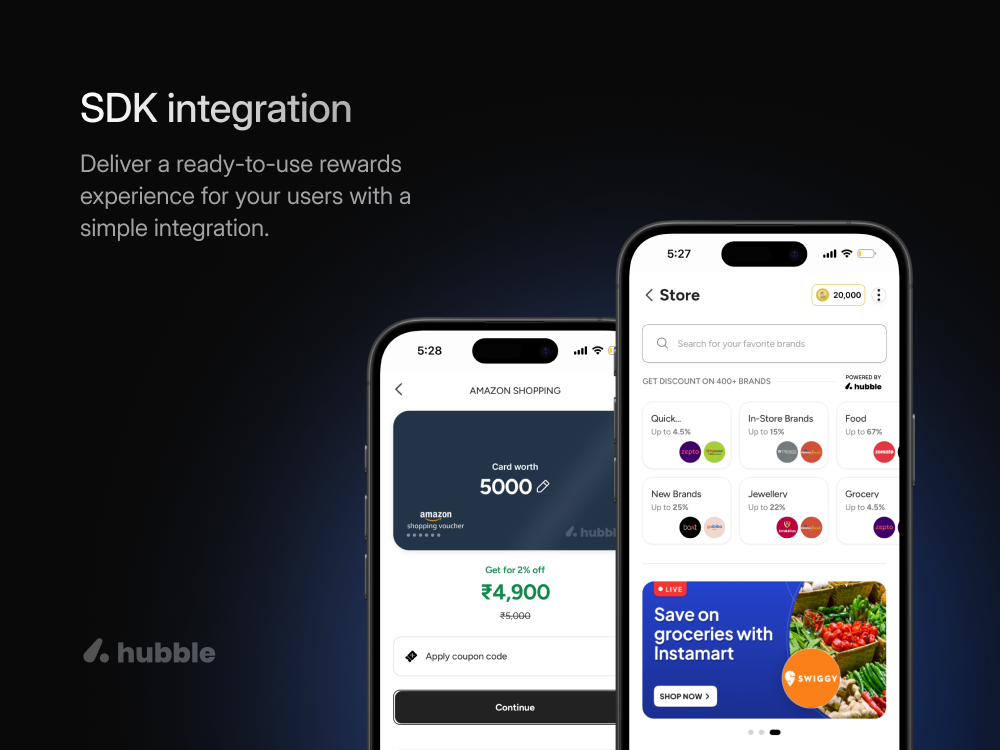
What is a rewards SDK and when to use it


What a rewards SDK actually is
A rewards SDK (Software Development Kit) is a set of pre-built libraries, components, and helper functions that developers embed directly into an application to handle reward-related actions. These actions typically include showing rewards, triggering earn events, handling redemptions, and syncing reward states with a backend system.
Unlike a standalone loyalty platform or an admin-driven portal, an SDK lives inside the app codebase. It operates close to the user interface and user actions. This proximity makes it useful for real-time interactions where rewards must appear instantly after an action.
An SDK usually connects to a backend service through APIs, but the developer does not have to build every interaction from scratch. The SDK abstracts common tasks such as authentication, event tracking, and UI rendering.
Core components of a rewards SDK
Client-side libraries
These are platform-specific packages for Android, iOS, web, or hybrid frameworks. They expose functions such as earnReward(), redeemReward(), or getUserRewards().
Event handlers
SDKs listen for in-app events like transactions, feature usage, or milestone completion. When configured, these events trigger reward logic without extra backend calls.
UI components
Many SDKs include ready-made UI elements such as reward banners, scratch cards, progress indicators, or reward lists. These reduce development time and maintain consistency.
Backend connectors
Even though the SDK runs in the app, it communicates with backend reward systems for rule validation, fraud checks, and settlement. The SDK simplifies this communication.
How a rewards SDK differs from a rewards API
A rewards API exposes endpoints that developers call explicitly. An SDK wraps those calls in higher-level functions and sometimes UI elements.
Key differences:
- APIs require developers to manage logic, retries, and error handling
- SDKs handle common flows automatically
- APIs are flexible but slower to integrate
- SDKs are opinionated but faster to ship
In practice, SDKs are built on top of APIs. Choosing an SDK does not remove the need for backend systems, but it reduces frontend complexity.
When a rewards SDK makes sense
You need fast integration
If the team needs to launch rewards quickly, an SDK saves time. Common reward patterns are already implemented, reducing development cycles.
Rewards are tightly coupled with user actions
For use cases like instant cashback, streaks, or gamified tasks, rewards must respond immediately to in-app behaviour. SDKs handle this better than server-only workflows.
You want consistent user experience across platforms
An SDK enforces uniform reward behaviour and UI across Android, iOS, and web. This reduces fragmentation caused by separate implementations.
You have limited frontend bandwidth
Teams with small frontend capacity benefit from SDKs because less custom logic is required.
When a rewards SDK is not the right choice
You need complex custom logic
If reward rules vary heavily by user segment, transaction type, or partner agreement, SDK abstractions may become restrictive. APIs or custom systems offer more control.
You operate at very large scale
High-scale systems often need fine-grained performance tuning, batching, and custom security layers. SDKs can become bottlenecks if not carefully designed.
You want backend-driven experimentation
If product teams frequently change reward rules without app releases, SDK-heavy setups can slow iteration. Backend-controlled APIs are better in such cases.
Common architectural patterns with rewards SDKs
SDK + central rewards API
The SDK handles UI and event capture. The API manages rules, eligibility, and settlement. This is the most common setup.
SDK for earn, API for redeem
Some systems use SDKs only for earning rewards while redemptions are handled through backend flows to reduce fraud risk.
SDK with feature flags
Feature flags allow teams to enable or disable reward logic remotely, reducing dependency on app updates.
Security considerations
Because SDKs operate on the client side, security boundaries matter. Sensitive logic such as reward eligibility, wallet balances, and settlement should never live fully in the SDK.
Best practices include:
- Server-side validation of all reward events
- Token-based authentication
- Rate limiting and anomaly detection
- Minimal trust in client-triggered actions
An SDK should act as a messenger, not an authority.
How to decide whether to use a rewards SDK
Product and engineering teams should evaluate:
- Speed of launch versus flexibility
- Frequency of reward rule changes
- Scale expectations
- Internal development capacity
A rewards SDK is most effective when used as part of a broader architecture, not as a standalone solution. It simplifies interaction but does not replace backend systems.
Summary
A rewards SDK is a practical tool for embedding reward experiences directly into apps. It reduces frontend complexity, accelerates delivery, and supports real-time user feedback. It is best suited for teams prioritizing speed, consistency, and tight coupling between actions and rewards. For complex or large-scale systems, SDKs should be paired with strong backend infrastructure rather than used in isolation.
Short summary