Platform partnerships in loyalty ecosystems


Why partnerships matter in loyalty ecosystems
Modern loyalty programs rarely succeed in isolation. As customer expectations rise, single-brand programs struggle to offer enough value, variety, or reach on their own. Platform partnerships allow loyalty ecosystems to extend beyond one product or brand and become part of a broader engagement network.
For enterprises, partnerships are not just about adding more rewards. They are about distribution, access to new audiences, and shared infrastructure. Well-designed partnerships turn loyalty from a closed system into an ecosystem that compounds value across participants.
In this context, loyalty platforms act as connectors, enabling alliances between brands, merchants, financial products, and service providers.
Defining platform partnerships in loyalty
Platform partnerships differ from simple vendor relationships. Instead of one party supplying rewards to another, multiple parties integrate into a shared loyalty layer.
These partnerships typically involve:
- Shared reward catalogs
- Cross-earning and cross-burning of points
- Integrated user journeys across platforms
- Coordinated incentives tied to joint outcomes
The platform’s role is to manage rules, settlement, attribution, and reporting so partners can focus on customer value rather than operational complexity.
Common partnership models in loyalty ecosystems
Brand-to-brand partnerships
In this model, two or more brands agree to offer reciprocal benefits. Users can earn or redeem rewards across participating brands.
This approach increases perceived value without each brand bearing the full cost. However, it requires careful alignment on audience overlap, brand positioning, and reward economics.
Brand-to-brand partnerships work best when partners serve complementary needs rather than competing ones.
Platform-led aggregation partnerships
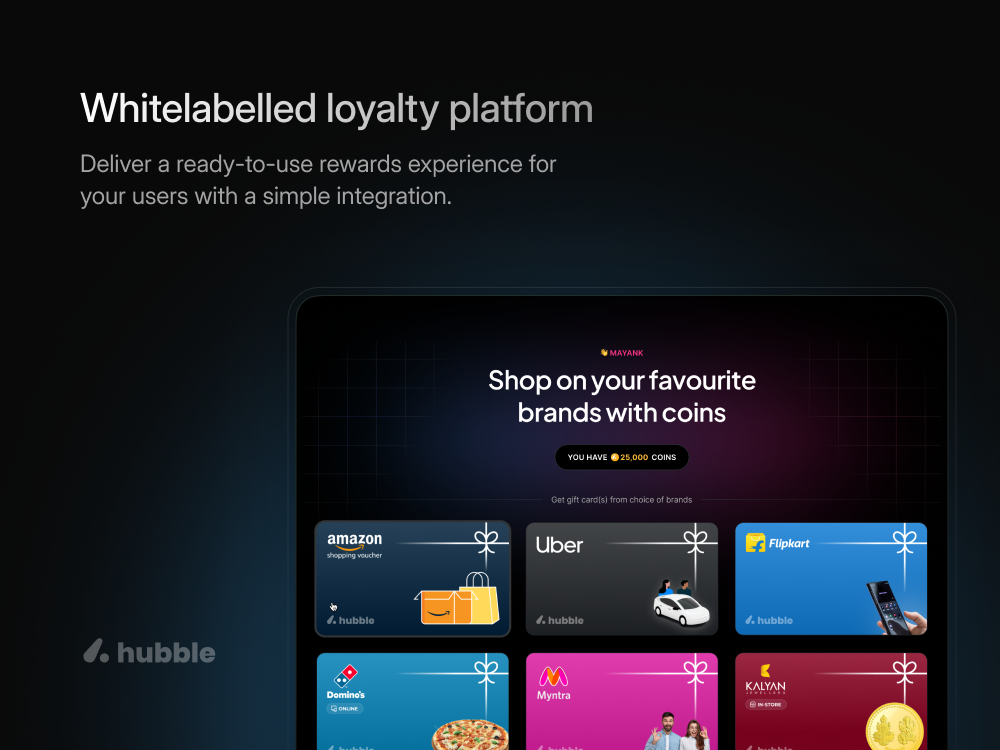
Here, a central loyalty platform aggregates multiple partners into a single ecosystem. Brands plug into the platform to access distribution and shared users.
This model scales faster than bilateral partnerships. It reduces integration effort for new partners and allows the ecosystem to grow incrementally.
The platform must enforce consistent standards for reward rules, user experience, and settlement to prevent fragmentation.
Distribution and channel partnerships
Some partnerships focus primarily on distribution. Loyalty programs integrate into wallets, payment apps, marketplaces, or super apps to reach users where they already transact.
In these cases, loyalty acts as a retention layer for the distribution partner and a growth channel for participating brands.
Success depends on seamless integration and clear value exchange between the platform and distribution partner.
Designing partnerships for mutual value
Aligning incentives across partners
Partnerships fail when incentives are misaligned. Each participant must see measurable value, whether through acquisition, increased frequency, or higher lifetime value.
Loyalty platforms must support flexible rule design to allocate costs and benefits fairly. Rigid structures create friction and limit partner engagement.
Managing brand control and experience
Partners often worry about losing brand identity within shared ecosystems. Poorly designed experiences can dilute brand perception.
Strong platforms allow partners to retain control over how their rewards appear, while maintaining a consistent system-level experience for users.
Balancing standardisation and flexibility is critical at scale.
Operational challenges in partnership ecosystems
Settlement and reconciliation
As partnerships scale, settlement becomes complex. Points earned with one partner may be redeemed with another, requiring accurate attribution and cost allocation.
Platforms must handle settlement transparently to maintain trust between partners. Manual processes do not scale in multi-partner ecosystems.
Data sharing and governance
Partnerships require clear rules on data access and usage. Over-sharing creates compliance risks, while under-sharing limits optimisation.
Enterprise ecosystems often rely on anonymised or aggregated data models to balance insight with privacy and regulation.
Onboarding and partner lifecycle management
Ecosystems evolve. New partners join, others exit, and terms change over time.
Platforms must support efficient onboarding, rule updates, and graceful exits without disrupting the broader ecosystem.
Platform partnerships as a distribution strategy
Expanding reach through alliances
Partnerships allow loyalty programs to access users they would not reach alone. Financial products, retail brands, and digital services can cross-pollinate audiences.
This shifts loyalty from a retention-only tool to a distribution channel.
Reducing acquisition costs
When users earn or redeem rewards across partners, acquisition costs are shared rather than duplicated. This improves unit economics for all participants.
Well-structured ecosystems reduce reliance on paid acquisition by embedding incentives into everyday user journeys.
Why partnerships shape the future of loyalty
Loyalty is moving from isolated programs to interconnected ecosystems. Platform partnerships enable this shift by lowering integration friction and aligning incentives across participants.
For enterprises focused on alliances and distribution narratives, loyalty platforms are no longer just reward engines. They are ecosystem enablers that connect brands, channels, and users into shared value networks.
The strength of a loyalty ecosystem is defined less by individual rewards and more by the quality of partnerships that sustain it.
Short summary