MyMcDonald’s Rewards: How McDonald’s Scaled Loyalty into a $33B Sales Channel

McDonald’s has been unusually explicit about loyalty at scale: it reports the size of its loyalty base, measures systemwide sales to loyalty members across 60 markets, and ties the entire initiative to its broader “Accelerating the Arches” strategy (specifically the “4Ds”: Digital, Delivery, Drive Thru, Development).
By 2024, McDonald’s stated its loyalty program reached 175M+ users across 60 markets, and it paired that growth narrative with operational upgrades such as “Ready on Arrival” to streamline ordering and pickup.
By Q2 2025, McDonald’s disclosed ~$33B in systemwide sales to loyalty members (trailing twelve months) and ~$9B for the quarter across those same 60 loyalty markets—placing loyalty squarely in “P&L-relevant” territory, not just marketing.
In parallel, third-party coverage of executive commentary indicates McDonald’s reached 185M 90-day active loyalty users in Q2 2025, while still describing the program as “not big enough” relative to their end-state targets.
This case study breaks down:
- Program design mechanics (simple points currency + redemption tiers + app-first identity)
- Technology & operations (cloud connectivity + fulfillment workflow changes)
- Results and what makes them transferable for product, growth, and platform teams
Company & Market Context
McDonald’s is running one of the world’s largest consumer loyalty efforts, but it frames loyalty as part of a bigger operational system. In its 2024 Annual Report shareholder letter, the company emphasizes “Accelerating the Arches” and the “4Ds”, explicitly calling out an unmatched “digital footprint” and the ongoing scaling of loyalty across 60 markets.
That matters because QSR loyalty isn’t purely a digital product. Unlike a software subscription, “retention” is constrained by:
- restaurant throughput (counter + drive-thru + pickup),
- menu availability,
- staffing patterns,
- and in many markets, franchise operator execution.
McDonald’s appears to have internalized this by treating loyalty + ordering as an “experience system” that spans technology and restaurant operations—evident in its discussion of the Restaurant Experience Team composition (operations, supply chain, franchising, delivery, and Speedee Labs).
Loyalty / Rewards Program Design
1) A single, easy-to-understand currency: points per dollar
On the U.S. Rewards program page, McDonald’s defines a simple earning rule: “Every $1 you spend earns 100 points”, with points tracked in-app.
Simplicity is strategic here. QSR loyalty fails when a points model requires too much cognitive load. McDonald’s chose a universal earn rate that can be localized but remains conceptually consistent.
2) Clear redemption tiers that map to real menu anchors
McDonald’s publishes redemption tiers in the app experience:
- 1500 points tier (e.g., small items like hash browns / cheeseburger / coffee)
- 3000 points tier (e.g., medium fries, 6pc nuggets)
- 4500 points tier (e.g., Filet-O-Fish, large fries)
- 6000 points tier (e.g., Big Mac, Quarter Pounder with Cheese, Happy Meal, 10pc nuggets)
This is a “menu-anchored catalog.” Instead of abstract perks, the rewards ladder is built on frequently purchased SKUs, which improves perceived value and redemption intent.
3) App-first identity and lightweight “earn/redeem” UX
The app flow is designed to work in multiple real-world restaurant contexts:
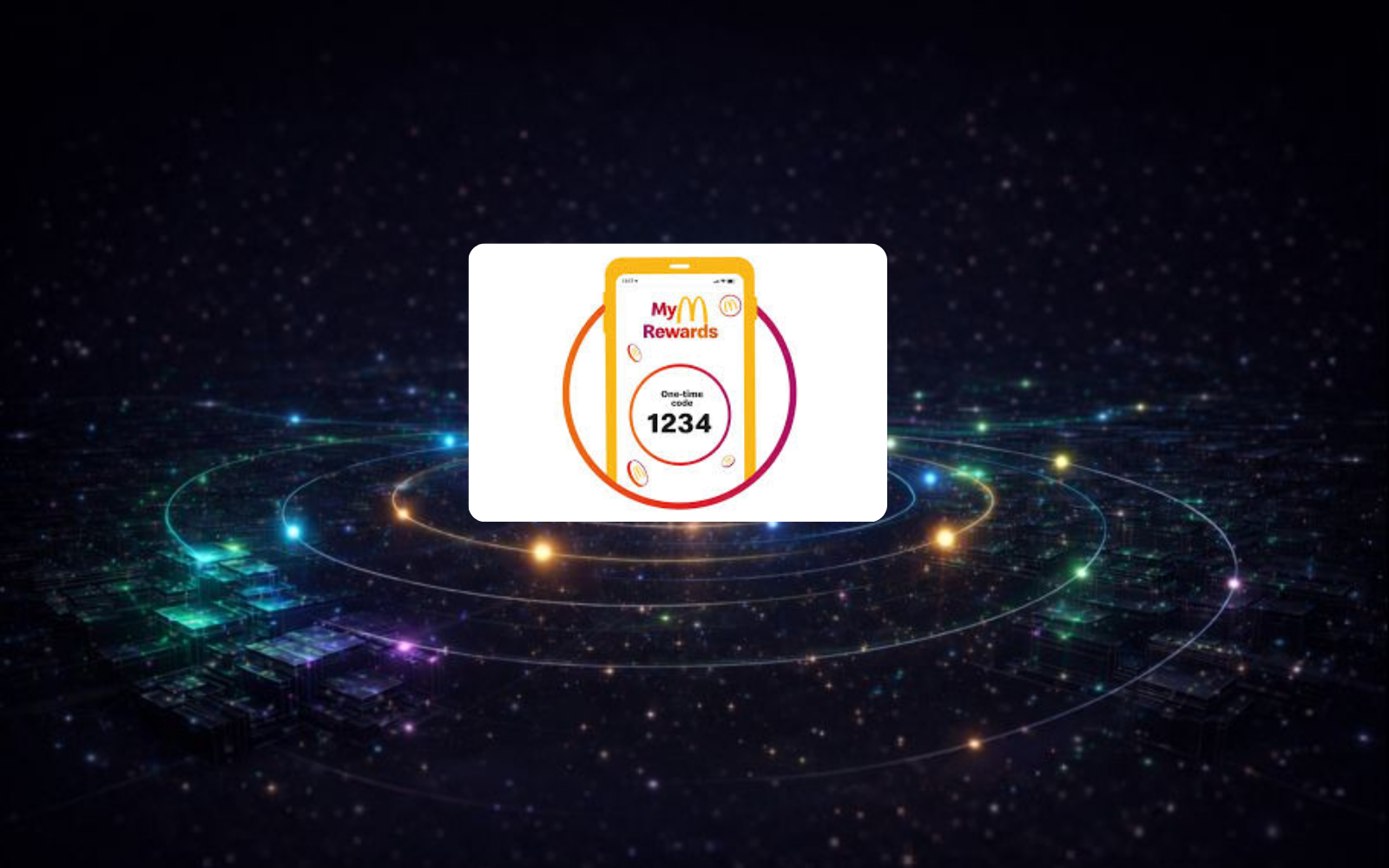
- A 4-digit code for drive-thru or in-store scanning to earn points
- Linked-card payment to “pay & earn” in one step (plus onboarding incentives like bonus points on first linked-card payment, per the U.S. page)
A subtle but important product choice: McDonald’s describes a single code handling redemption while still earning points on additional spend in the same transaction—reducing cashier friction and queue time.
Technology & Operations
1) “Loyalty at scale” requires restaurant connectivity (cloud as the foundation)
McDonald’s 2023 announcement explicitly ties future growth targets to infrastructure: connecting thousands of restaurants worldwide with Google Cloud technology, starting in 2024, to improve operations and customer/crew experience.
This is a key architectural signal: the program’s success isn’t only in the app. It depends on consistent, low-latency connectivity to support ordering, offers, identification, and operational telemetry across a massive physical footprint.
2) Operational workflow upgrades to reduce friction (Ready on Arrival)
In the 2024 Annual Report shareholder letter, McDonald’s highlights “Ready on Arrival” deployment across its top six markets, describing it as streamlining ordering and convenience.
While McDonald’s doesn’t publish the full system design in that letter, the intent is clear: loyalty and mobile ordering create pickup/queue management problems; “Ready on Arrival” is one operational answer—essentially tightening the handoff between digital intent (app order) and physical fulfillment (food ready at the right moment).
3) Org design as part of the platform
McDonald’s describes evolving its customer experience organization into a Restaurant Experience Team that explicitly includes Operations, Supply Chain, Franchising, Delivery, and Speedee Labs, alongside other global roles.
This is a meaningful structural choice. Loyalty is treated as a cross-functional operating system rather than a marketing feature—because the program’s performance is inseparable from operations (speed, accuracy, staffing, inventory availability).
Results & Metrics (Verified)
Loyalty user scale
- 150M 90-day active users (baseline cited in Dec 2023 corporate announcement)
- 175M+ users across 60 markets in 2024 (shareholder letter)
- 185M 90-day active users in Q2 2025 (as reported by CX Dive, citing CEO framing and goals)
Loyalty-attributed systemwide sales
- Over $20B systemwide sales to loyalty members (baseline in Dec 2023 announcement)
- ~$33B trailing-twelve-month systemwide sales to loyalty members across 60 loyalty markets and ~$9B for the quarter (Q2 2025 earnings release)
Public targets (explicit end-state ambition)
McDonald’s stated goals for 2027:
- 250M 90-day active loyalty users
- $45B annual systemwide sales to loyalty members
These targets matter because they define the program not as “retention marketing,” but as a global sales channel with a disclosed run-rate trajectory.
Insight Synthesis: Why This Worked (and What’s Non-Obvious)
1) The points system is deliberately boring—and that’s the advantage
The design is straightforward: spend → points → redeem menu items at visible tiers.
For QSR, “boring” beats “clever.” The primary job is to get customers to reliably identify themselves (app) and repeat purchases. Complexity would reduce scan rates, slow queues, and increase support costs.
Transferable pattern: If your product depends on high-frequency behavior, optimize for comprehension speed over novelty.
2) McDonald’s measures loyalty as “systemwide sales,” not just engagement
Many loyalty programs brag about downloads or signups. McDonald’s discloses systemwide sales to loyalty members and links it to long-term growth goals.
That framing forces a higher standard internally: offers, personalization, and UX changes must ultimately translate into measurable sales outcomes.
Transferable pattern: Define a top-level metric that finance can audit (sales, margin proxy, throughput uplift), not just “member growth.”
3) Loyalty becomes an ops problem at scale—so they built the ops layer
Ready on Arrival is a signal that digital convenience can’t outgrow restaurant reality without new fulfillment workflows.
Similarly, Google Cloud connectivity suggests the company is investing in consistent infrastructure across restaurants to make the digital layer dependable.
Transferable pattern: Rewards drive demand shaping; demand shaping requires operational capacity shaping. If you don’t own the ops layer, your rewards layer eventually stalls.
4) The program is also a franchise governance tool (implicitly)
Even though the sources here don’t quantify franchise-level adoption, the combination of standardized digital workflows, cloud connectivity, and an org model that includes franchising in the Restaurant Experience Team strongly implies the program is used to “systematize” execution across operators.
Transferable pattern: In distributed networks (franchisees, agents, partners), loyalty can double as an execution standardization mechanism—if the tooling is consistent and the economics are aligned.
What Other Teams Can Apply
For product & growth teams building loyalty inside a consumer app
- Use a single universal currency (e.g., points per spend) and publish clear redemption ladders.
- Reduce identification friction (scan/code flow that works in messy real-world contexts).
- Measure outcomes in commercial terms: a “loyalty sales” metric creates accountability.
For platform/infra teams
- Assume physical-world constraints: build workflow products like Ready on Arrival if demand is created digitally.
- Invest in connectivity/standardization: cloud connectivity across distributed endpoints is part of the loyalty stack, not an IT footnote.
- Org design matters: if ops and supply chain aren’t in the loyalty operating model, the program will plateau.
🔗 References
- McDonald’s 2024 Annual Report to Shareholders — loyalty scale (175M+ users, 60 markets), “4Ds,” Ready on Arrival deployment.
- McDonald’s corporate announcement (Dec 6, 2023) — baseline 150M 90-day active users, $20B+ loyalty sales; targets 250M and $45B; Google Cloud rollout starting 2024.
- McDonald’s Q2 2025 results — ~$33B trailing-twelve-month systemwide sales to loyalty members across 60 markets; ~$9B quarterly.
- Customer Experience Dive (Aug 2025) — 185M 90-day active users in Q2 2025; program growth goals framing.
- McDonald’s U.S. MyMcDonald’s Rewards page — earn rate, redemption tiers, and app-based code/scan flows.
Short summary