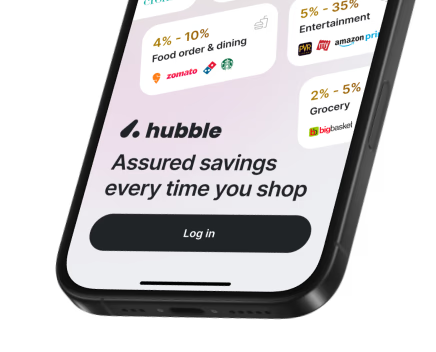
Integrating Third-Party Reward Catalogs


Why third-party reward catalogs matter
Third-party reward catalogs allow platforms to expand reward options without building merchant relationships from scratch. Instead of negotiating, onboarding, and managing hundreds of vendors, teams can plug into an existing catalog that already handles sourcing, pricing, and fulfillment, whether that catalog is accessed through an amazon gift card api or a similar provider-led integration.
For alliance-led growth and distribution-focused teams, catalogs act as leverage. They make it easier to enter new markets, support partner-led use cases, and launch incentives quickly across multiple programs. The trade-off is reduced control, which needs to be managed deliberately.
Common integration models
Aggregator-based catalogs
Aggregators bundle multiple brands, vouchers, and experiences into a single catalog. Integration usually happens through APIs that expose catalog browsing, pricing, availability, and redemption flows.
This model is best when speed and coverage matter more than customization. It is commonly used by fintech apps, employee benefit platforms, and channel incentive programs that rely on providers such as a gyftr gift card api or a broader xoxoday api.
Direct brand partnerships
Some platforms integrate directly with a small set of high-value brands. This requires more effort but allows tighter control over pricing, branding, and redemption experience.
Direct integrations work well for premium programs where differentiation matters more than breadth.
Hybrid setups
Many mature systems combine both approaches. Aggregators cover long-tail rewards, while direct partnerships support flagship rewards. The integration layer decides which catalog to surface based on context, user segment, or campaign type, sometimes mixing providers accessed via a gyftr api with internally managed catalogs.
Key technical considerations
Catalog ingestion and updates
Third-party catalogs change frequently. Prices, availability, and terms can shift without notice. Integrations must support regular syncs and graceful handling of outdated entries.
Teams should avoid hardcoding catalog data. Catalogs should be treated as dynamic inputs, not static assets.
Redemption flow ownership
One critical decision is who owns the redemption experience. In some setups, users are redirected to the partner. In others, redemption happens fully inside the platform.
Redirect-based flows are faster to launch but introduce drop-offs and reduce visibility. Embedded redemption offers better tracking and user experience but requires tighter integration and error handling, especially when operating as a full voucher management platform.
Failure handling and reversals
Redemption failures are inevitable. Systems need clear rollback logic, refund handling, and user communication flows. Without this, support load increases and trust erodes quickly.
Integration contracts should define responsibility clearly when redemptions fail or get delayed.
Partner and ecosystem implications
Control vs reach trade-off
Third-party catalogs increase reach but reduce control. Teams give up flexibility on pricing, reward formats, and sometimes even branding.
This trade-off is acceptable when catalogs are used as infrastructure, not as the core differentiator. If rewards are central to positioning, over-reliance on generic catalogs weakens the narrative.
Revenue and margin structures
Catalog partners typically operate on margins or commissions. These costs must be factored into incentive economics early. What looks cheap at small scale can become expensive as volumes grow.
For alliance teams, transparency on pricing tiers and volume discounts is essential to maintain sustainable partnerships.
Dependency risk
Relying on a single catalog partner creates platform risk. Changes in terms, outages, or catalog shrinkage can disrupt multiple programs at once.
Mitigation strategies include multi-catalog support and abstraction layers that allow switching partners without major rewrites.
Governance and compliance considerations
Catalog rewards often have tax, regulatory, or geographic restrictions. Gift cards, vouchers, and experiences may be treated differently across regions.
Platforms must not assume that catalog providers fully handle compliance. Responsibility often remains with the platform offering the incentive, especially in regulated industries.
Clear documentation and periodic audits help prevent downstream issues.
How integration supports distribution narratives
Third-party catalogs are not just a technical choice. They enable distribution stories. A platform that supports multiple catalogs can onboard partners faster, launch joint campaigns, and adapt rewards to partner audiences.
For alliance teams, this flexibility strengthens co-selling and co-marketing efforts. Partners care less about how rewards are sourced and more about how easily they can be activated.
When third-party catalogs are the wrong choice
Catalogs are a poor fit when reward differentiation is the primary growth lever, when margins are extremely tight, or when user experience must be tightly controlled end to end.
In such cases, selective direct partnerships or internally managed rewards may be more effective, even if slower to launch.
Closing perspective
Integrating third-party reward catalogs is an ecosystem decision, not just an engineering task. Done well, it accelerates partnerships, supports rapid distribution, and reduces operational overhead. Done poorly, it creates hidden costs, dependency risk, and fragmented experiences.
Teams should treat catalogs as modular components within a broader incentive system, choosing integration depth and partner models based on long-term alliance goals rather than short-term convenience.
Short summary