Integrating loyalty into fintech and HR tech platforms


Why loyalty integration is an architectural concern
In fintech and HR tech platforms, loyalty is rarely a standalone feature. It intersects with payments, compliance, identity, reporting, and financial controls. Treating loyalty as a plug-in or marketing layer often leads to fragile integrations and operational issues at scale.
Enterprise platforms integrate loyalty to influence specific behaviours: transaction frequency, repayment discipline, employee engagement, or performance outcomes. Achieving this requires architectural alignment rather than surface-level integrations.
For enterprise teams, the key question is not whether to add loyalty, but how to integrate it without disrupting core systems.
Integration challenges unique to fintech and HR tech
Regulated data and compliance constraints
Fintech and HR tech platforms operate in highly regulated environments. User data, financial records, and employment information are subject to strict controls.
Loyalty systems must integrate without expanding compliance scope unnecessarily. Poor integration can introduce audit risks, data exposure, or unclear ownership between systems.
This makes deep architectural planning essential before introducing rewards or incentives.
High dependency on core workflows
In fintech platforms, loyalty often depends on transactions, repayments, or balances. In HR tech, it may depend on attendance, performance cycles, or tenure.
If loyalty logic is tightly coupled to these workflows, failures can cascade. Integration strategies must avoid blocking or degrading core user actions.
Common integration models used in practice
Embedded loyalty via APIs
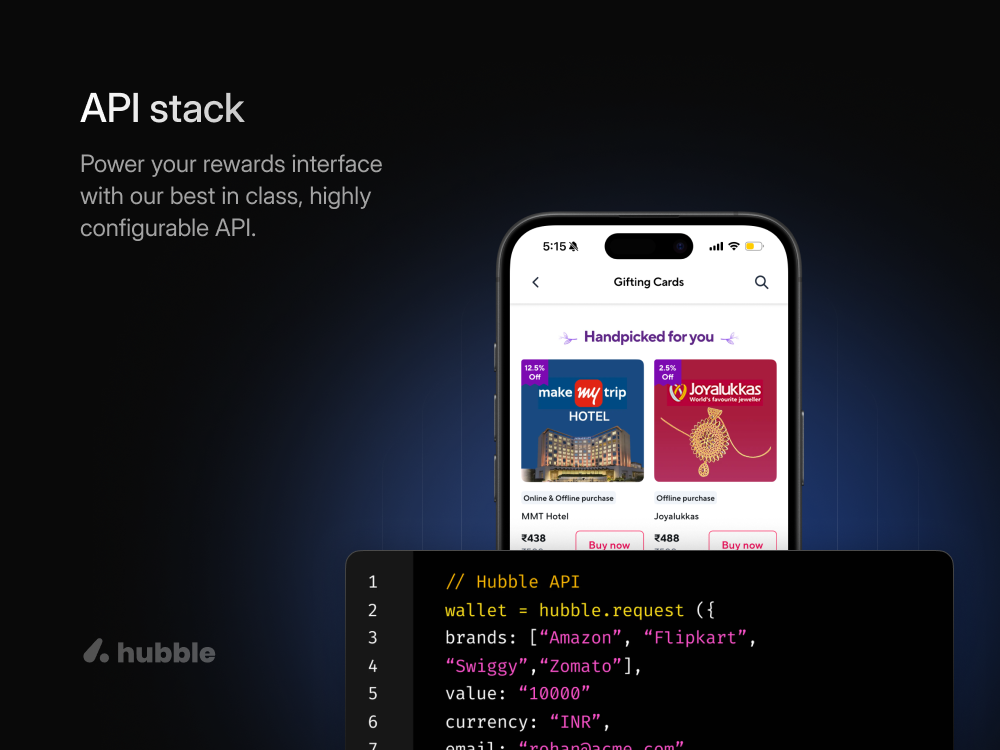
Many enterprise platforms integrate loyalty by embedding reward issuance and redemption through APIs. Core systems trigger events, while loyalty execution happens externally.
This model allows platforms to retain ownership of business logic and user experience while outsourcing fulfillment, catalogs, and partner management.
It also simplifies compliance boundaries by limiting data exchange to required fields only.
Platform-level orchestration
Some enterprises integrate loyalty as part of a broader orchestration layer. Events from multiple systems feed into a central rules engine that decides when rewards apply.
This approach suits complex organisations but introduces additional operational overhead. Clear ownership and monitoring are required to avoid silent failures.
Native module integration
In rare cases, platforms build loyalty modules internally and integrate them directly into core services. This provides maximum control but increases long-term maintenance costs.
This approach is usually reserved for organisations where loyalty is considered a core capability rather than a supporting system.
Designing event-driven loyalty integrations
Event definition and ownership
Successful integrations begin with clear event definitions. Teams must decide which system owns event generation and which system consumes it.
Events should represent completed actions, not intentions. For example, a successful repayment event is safer than a repayment initiation event.
Clear ownership prevents duplication and reward leakage.
Asynchronous processing
Loyalty processing should not block core workflows. Event-driven, asynchronous processing ensures that rewards do not delay transactions, payroll runs, or employee actions.
Asynchronous models also improve resilience. If the loyalty system is unavailable, core systems continue operating.
Idempotency and retries
At enterprise scale, duplicate events are unavoidable. Integrations must support idempotency to prevent duplicate rewards.
Retry mechanisms should be carefully designed to avoid over-crediting during partial failures.
Data flow and visibility considerations
Minimal data exchange
Loyalty integrations should exchange only what is necessary. Excessive data sharing increases compliance risk and complicates audits.
Identifiers, timestamps, and outcome signals are often sufficient for most loyalty use cases.
Reporting and reconciliation
Finance and operations teams require visibility into reward costs, redemptions, and liabilities.
Integrations must support downstream reporting without relying on manual reconciliation between systems.
Clear data contracts simplify cross-team accountability.
Operational concerns at enterprise scale
Failure isolation
Loyalty systems should fail gracefully. If reward issuance is delayed, users should still complete transactions or workflows.
Graceful degradation preserves trust and prevents support escalation.
Change management
Enterprise platforms evolve continuously. Loyalty integrations must tolerate changes in upstream schemas, workflows, and business rules.
Loose coupling and versioned APIs reduce breakage during platform updates.
Why loyalty integration decisions shape long-term outcomes
Integrating loyalty into fintech and HR tech platforms is not a tactical decision. It shapes how easily teams can experiment, scale programs, and maintain compliance over time.
Architectures that embed loyalty thoughtfully enable growth without increasing operational risk. Poorly integrated systems create hidden dependencies that surface only under scale.
For enterprise teams, loyalty integration is best treated as an architectural capability, not a feature request. The quality of this integration determines whether loyalty remains an asset or becomes a long-term constraint.
Short summary