How Rewards Work in Credit Card Platforms | API-Based Incentives Explained


Remember, rewards are an engagement layer — Not a Core Banking Function
In modern credit card platforms, rewards do not live inside:
- Core banking systems
- Card network rails
- Settlement or clearing systems
Instead, rewards function as an event-driven engagement layer that reacts to user behaviour without touching sensitive financial data.
This separation is intentional and critical for:
- Security
- Compliance
- Faster iteration cycles
Common credit card reward triggers
Credit card platforms typically trigger rewards on:
- First successful card transaction
- Monthly spend milestones
- Category-based spends (fuel, travel, dining)
- EMI conversion events
- Utility & bill payments
- Dormant card reactivation
- Cross-sell actions (insurance, loans)
Triggers are configurable and can be adjusted without redeploying core systems.
End-to-End Rewards Flow (API Model)
- A transaction or behaviour occurs inside your platform
- Internal rules engine evaluates eligibility
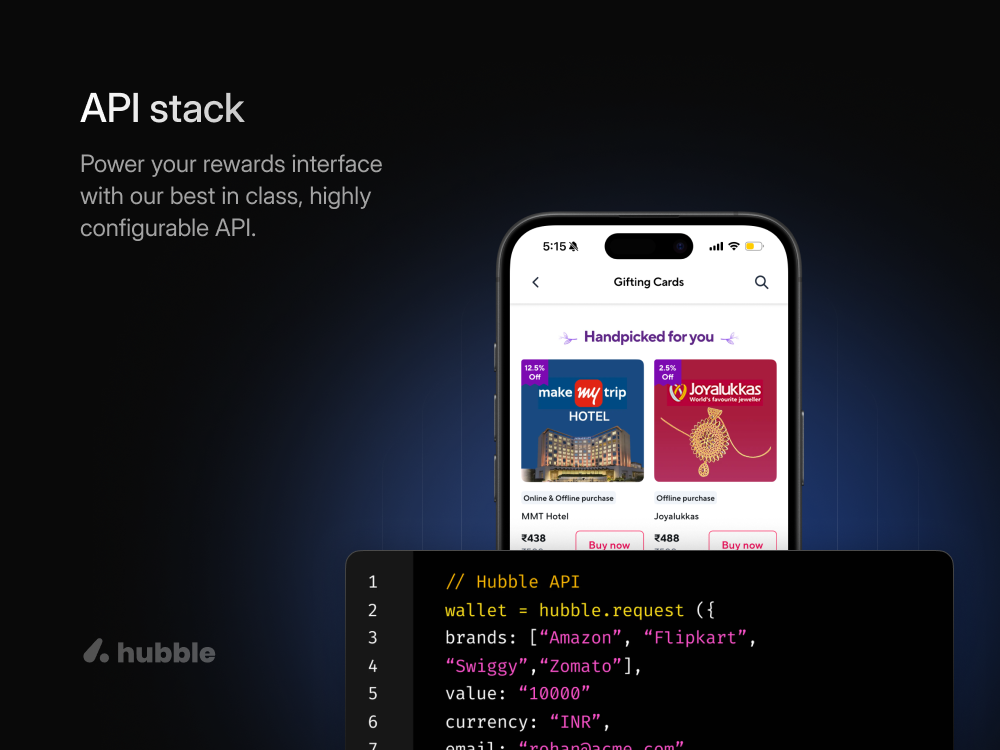
- A reward event is sent to Hubble via API
- Coins are credited instantly to the user wallet
- The user redeems a brand gift card on demand
At no point does Hubble receive:
- Card PAN data
- Settlement details
- Sensitive financial identifiers
This keeps rewards decoupled, auditable, and low-risk.
How to choose the right Issuance model
Real-time rewards
- Used for activation and engagement
- Higher perceived value
- Immediate behavioural reinforcement
Batch rewards
- Used for monthly milestones
- Lower system dependency
- Suitable for legacy stacks
Most platforms adopt a hybrid model.
Reward logic Is business logic. It has to align with business goals.
Typical rule parameters include:
- User eligibility (new vs existing)
- Spend thresholds
- Category inclusion/exclusion
- Frequency caps
- Cool-down periods
- Campaign start and end dates
Rules sit outside the card engine, enabling faster testing and budget control.
How Users Experience Rewards
Rewards appear inside:
- Existing credit card app UI
- Rewards or wallet section
- Post-transaction notifications
Users do not need a separate app or login.
Redemption remains embedded in the platform flow.
How Reward Abuse Is Controlled
Common safeguards include:
- Per-user reward caps
- Velocity throttling
- Device-level checks
- Transaction pattern monitoring
- Redemption anomaly detection
These controls operate independently from payment risk engines.
Why This Model Is BFSI-Safe
This architecture ensures:
- Zero card data exposure
- No impact on settlement flows
- Clear audit trails
- Simple RBI audit explanations
- Non-monetary reward classification
Short summary