Build vs Buy vs Embed: Choosing the Right Loyalty Architecture


Why loyalty architecture is a strategic decision
Loyalty is no longer a marketing add-on. For many businesses, it sits at the intersection of product, growth, payments, and data. The architecture chosen to support loyalty directly affects speed to market, experimentation ability, operational cost, and long-term scalability.
Teams evaluating loyalty program platforms or incentive systems typically face three options: building a system internally, buying a third-party rewards solution, or embedding loyalty capabilities via APIs. Each option has trade-offs that extend beyond features and pricing into governance, flexibility, and risk.
This decision is especially critical for sales incentive software and complex reward programs, where incentive logic becomes tightly coupled with revenue-driving workflows.
Defining the three approaches clearly
Building a loyalty platform in-house
Buying means adopting an off-the-shelf rewards platform with prebuilt dashboards, configuration tools, and reporting. These platforms are designed to support a wide range of use cases with minimal setup.
Teams choose this route when loyalty is considered core intellectual property or when existing platforms cannot support highly customised workflows. While building provides full control, it also creates long-term engineering and operational ownership.
Buying a loyalty or rewards platform
Buying means adopting an off-the-shelf rewards platform with prebuilt dashboards, configuration tools, and reporting. These platforms are designed to support a wide range of use cases with minimal setup.
This approach enables faster initial launch and predictable pricing. However, teams often need to adapt internal processes to platform constraints, especially as use cases grow more complex.
Embedding loyalty via APIs
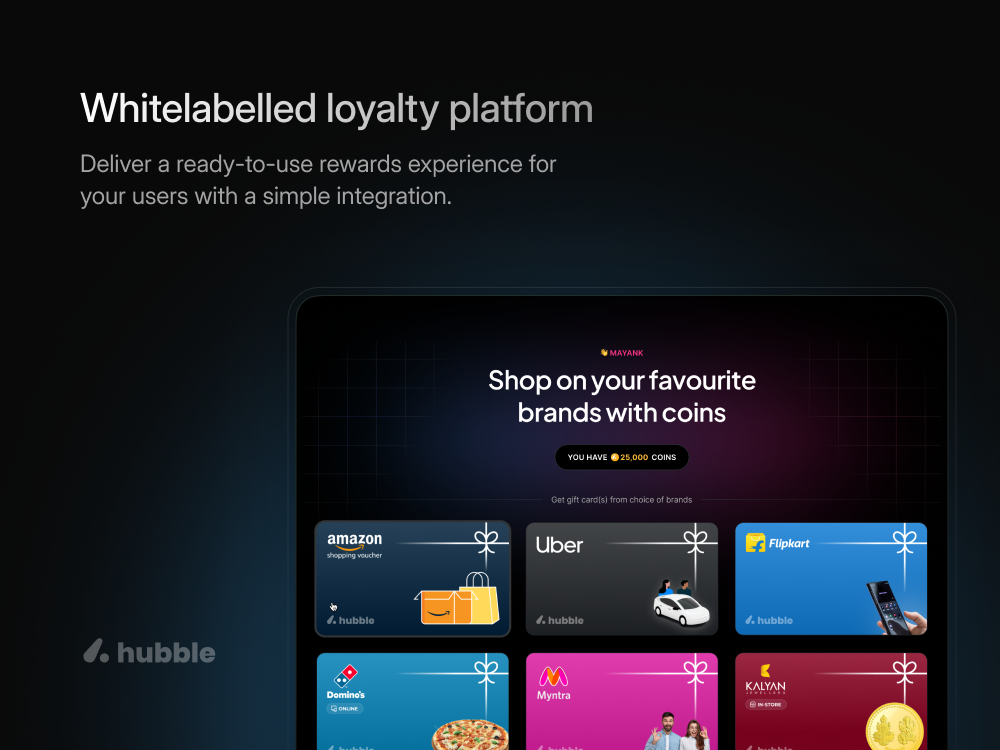
Embedding sits between build and buy. Teams integrate reward issuance and incentive execution into their product using APIs, while retaining ownership of logic, experience, and data.
This model allows businesses to outsource fulfillment and catalog management while keeping strategic control in-house.
Key evaluation criteria for loyalty architecture
Time to market and experimentation speed
Building from scratch typically requires months before core functionality is usable. Iteration speed depends on engineering availability, which can slow experimentation.
Buying enables the fastest launch but may limit flexibility once configuration boundaries are reached.
Embedding offers a balance, enabling faster experimentation than building while avoiding the rigidity of full platforms.
Control over logic and user experience
Building provides maximum control over reward rules, eligibility logic, and user experience. This matters when incentives are deeply tied to product behavior.
Bought platforms abstract logic through configuration layers, which may struggle with edge cases.
Embedding allows teams to control logic and experience while delegating execution, which suits many incentive management software needs.
Scalability and operational overhead
Scalability includes fraud prevention, reconciliation, compliance, and vendor management, not just traffic handling.
Built systems require teams to manage these concerns internally as volume grows. Bought platforms absorb much of this overhead but may impose usage limits or pricing tiers.
Embedding allows teams to control logic and experience while delegating execution, which suits many incentive management software needs.
Cost considerations beyond licensing
Engineering and maintenance costs
Building carries high upfront engineering costs and ongoing maintenance, regardless of reward usage.
Buying converts much of this into recurring platform fees but may introduce indirect costs through workarounds and vendor dependencies.
Embedding reduces build complexity without committing to full platform pricing, offering cost flexibility as programs evolve.
Incentive leakage and inefficiency
Poorly designed systems increase incentive leakage through abuse or duplication.
Built systems require strong internal controls. Bought platforms often include safeguards but may limit visibility.
Embedded architectures can combine internal controls with external execution to reduce leakage if designed carefully.
Vendor dependency and long-term flexibility
Lock-in risk
Bought platforms often create dependency through proprietary rule models and reporting structures. Exiting later can be difficult.
Building avoids vendor lock-in but creates dependency on internal teams and legacy code.
Embedding reduces lock-in by keeping data and logic internal while using vendors primarily for execution.
Ecosystem and integration fit
Loyalty systems must integrate with CRM, analytics, payments, and finance tools.
Bought platforms may offer limited native integrations. Embedding generally fits better into existing ecosystems without forcing process changes.
Matching architecture to business maturity
Early-stage and fast-scaling teams
Teams prioritising speed and validation often benefit from embedding rather than building or fully buying. This enables rapid iteration with limited overhead.
Mid-stage platforms with growing complexity
As incentive logic becomes more nuanced, embedding or selective buying often provides the right balance of control and speed.
Enterprises and regulated environments
Enterprises may build or deeply embed to meet compliance, audit, and governance requirements that generic platforms cannot support.
Making the decision intentionally
There is no universally correct choice between build, buy, and embed. The right loyalty architecture depends on how central incentives are to the business and how much control and operational ownership teams can sustain.
Teams evaluating rewards platforms, loyalty program platforms, or sales incentive software should prioritise architectural fit over feature lists. The cost of the wrong decision usually appears later, when scale and dependency increase.
Choosing the right loyalty architecture is a long-term systems decision, not a short-term procurement one.
Short summary